
Storybelly Digest: Treekeeping
On holding fast, letting go, and trusting the understory

So she finally came down, the majestic silver maple that has lived at the edge of my forest garden for more than fifty years. When she hadn’t leafed out for years, we coppiced her, cutting the limbs and trunk back to create a snag for wildlife.
Still, weakened limbs occasionally fell, sometimes in our neighbor’s back yard. We cut off the limbs to create a luxury apartment complex and hoped for bats or woodpeckers or squirrels, nuthatches, even a possum in the rotting base.
But our silver maple girl had other ideas. She burst back to life, pushing out massive, multi-branched epicormic boughs. She built a dense new canopy, but instead of reaching back toward the sky, it topped out at thirty feet. Because her huge limbs were weakly attached to the decaying trunk, they threatened to drop under their own weight.
As the tree began to decompose, we planted her successors: a young river birch on the north side and, about thirty feet away on her west side, a wisp of a red maple I had purchased for eight dollars at the Wylde Center plant sale one spring.


The river birch and the red maple — now four years and six years old, respectively — have been suffering under the silver maple’s intense shade ever since. Their trunks have leaned and twisted in a search for sun. The darkness under the silver maple created a “grotto” (Jim’s word) under a small, bushy stand of Chickasaw plums, and they stopped producing fruit.
So the silver maple — which had sections of rot from the trunk to the top — became a dangerous proposition in the forest garden, and, as stewards of this little certified wildlife habitat, the tree had to go. I held off as long as I could, until I could see that we had no better choice.


But she is still here. We left the stump where it was, and had Matt and his crew cut the trunk into rounds. We rolled them into the forest garden, where they will help with erosion and, as they slowly decompose, provide food, shelter, and habitat for salamanders and beetles and frogs and insects of all kinds.


The limbs and branches and leaves went through the chipper. At the end of the day they were dumped onto our driveway. We’ve got a lot of good work ahead of us now to spread those silver maple chips back in that forest area and in other garden areas that could use the mulch.
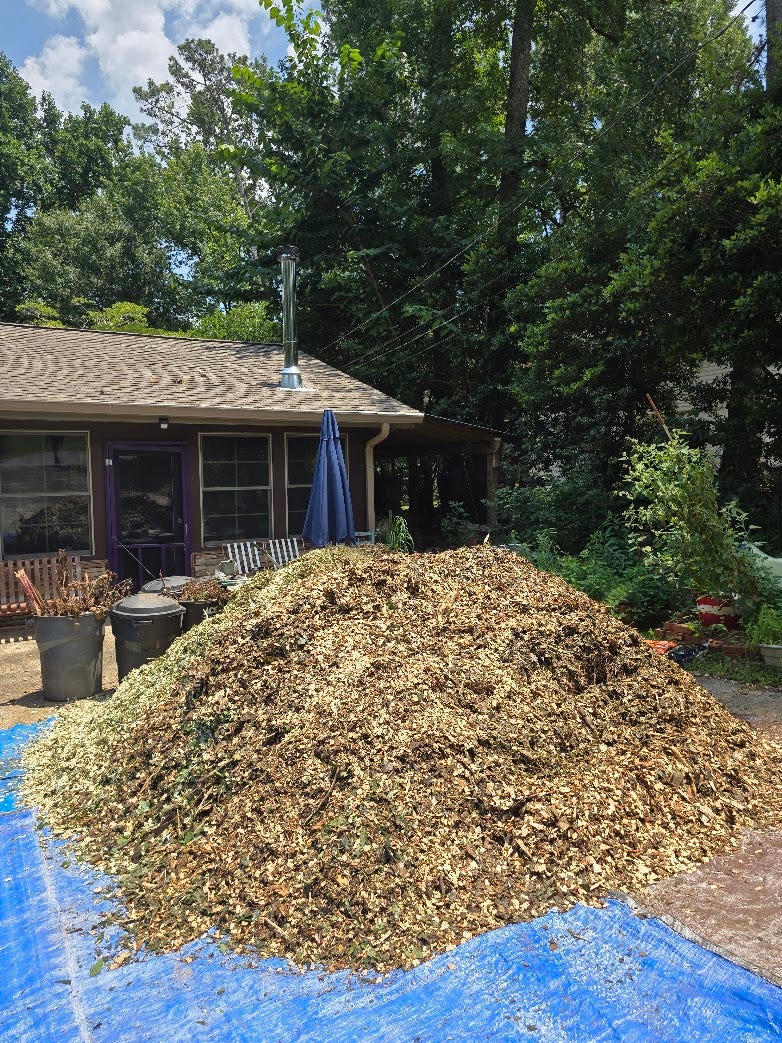
I envision the mycelium network underground these days, whispering from tree to tree, about the demise of the silver maple while welcoming its parts and pieces to nourish the biosphere here as the sun comes back to that corner of the forest garden, where the nectarines and Chickasaw plums have been asking for enough light for them to set fruit, and where the creatures and plants that call the little wildlife pond home are sighing with relief. A little dappled sun again! Perfect.
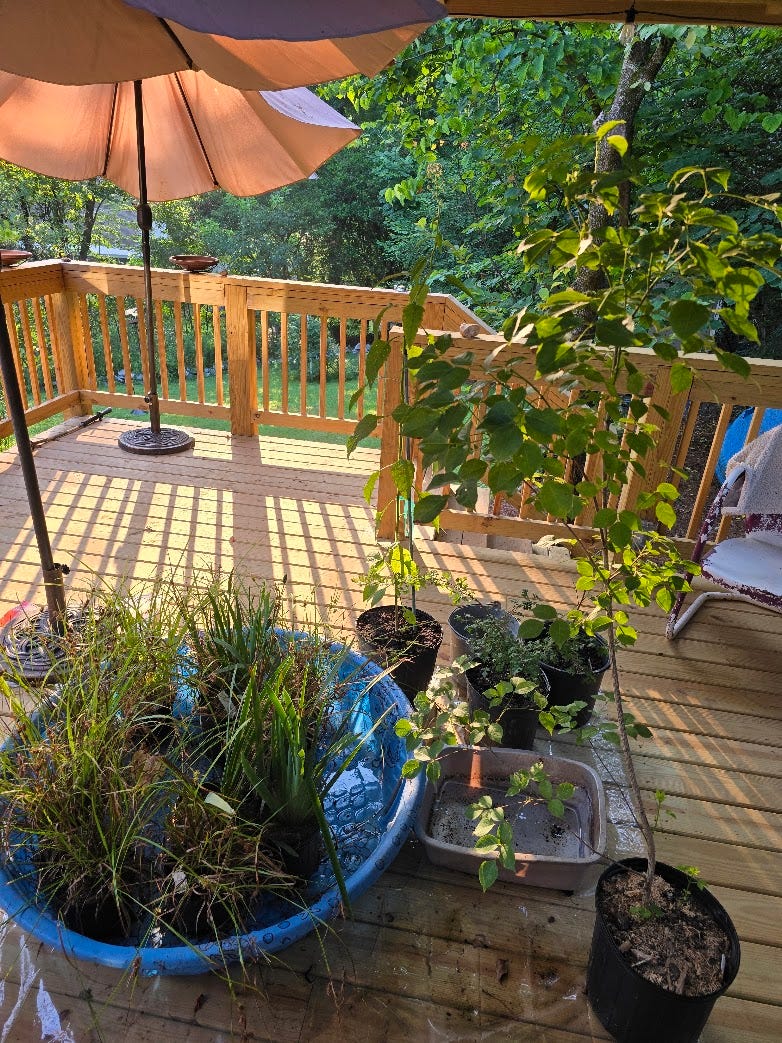
Meanwhile, back at the ranch, we have a little native plant nursery chugging along on the back deck, under a roofed pergola, where I daily plump pillows, take temperatures, and dispense drinks of water. These plants and small understory trees will be planted in the area the silver maple dominated.
I feel a kinship with my silver maple. I didn’t want to let her go. While she was growing, so was I. I’ve spent more than fifty years tending stories rooted in childhood, memory, history, curiosity, and questions.
Some of those stories have turned into books. Most of them haven’t. Every one of them gave me something I needed in order to write the next story. There is a faithfulness in that, in the same way my tree was faithful. It wanted to live.
Stories are no different. They ask for our attention. They ask for our time. They ask for our wonder.
Standing in the driveway, looking at that mountain of silver maple chips, I found myself thinking the same thing I tell my writing students:
Nothing is wasted.
xo Debbie
This is so beautiful and touches my heart in a lot of places. I honor you for tending her and for letting her go with dignity, and for finding ways to let her feed the future. 🌳
“Nothing is wasted.” So true on many levels. Thanks Deb.🌻